

Fishing Games in 2026: Genre Development, Studio Comparison and Room Systems
Fishing games are multiplayer shooting games in which a cannon fires at sea creatures swimming across a shared screen, and each capture pays the shot value multiplied by the target’s prize figure. In this article, we at MCW Casino give a short introduction to the genre, its origins, its rules, the studios behind it and the way we present it in our lobby.
The format sits between slot machines and arcade shooters. A screen full of moving targets, a turret on the edge of the frame and a multiplier on every creature make it one of the most recognisable products in Asian digital entertainment.

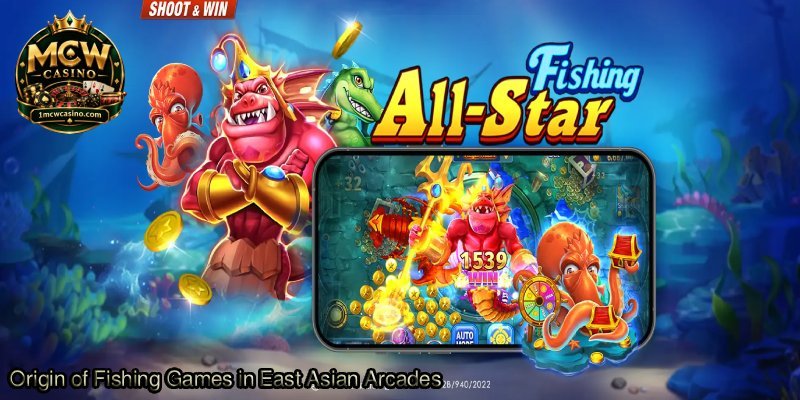
Origin of Fishing Games in East Asian Arcades
The genre began as a physical arcade product in East Asia in the late 2000s. Large table cabinets with a shared horizontal screen let several people sit around the edges, each controlling a turret aimed at fish crossing the display. Ocean King, built by the Taiwanese manufacturer IGS, became the best-known cabinet series and set many conventions that fishing titles still follow.
Those cabinets fixed the basic loop. Each shot costs credits, each target carries a multiplier, and the chance of a capture falls as the target’s value rises. Whales, dragons and mythical bosses carried the highest values, while special targets triggered weapons that could clear part of the screen at once.
From Cabinets to Phones
Mobile internet spread through the 2010s, and studios rebuilt the format for browsers and smartphones. The shared cabinet became a virtual room, the physical turret became a touch-controlled cannon, and coins gave way to digital balances. Server-side engines replaced the cabinet’s internal board.
Online versions also widened the format. Jackpot meters, bonus wheels, evolving bosses and auto-targeting arrived, and themes moved into space, dinosaurs, zombies and Chinese mythology. The shoot-and-capture core stayed the same throughout.
Popularity in Asia and Bangladesh
Demand remains strongest in mainland China, Taiwan, Vietnam, the Philippines, Malaysia and Indonesia, where arcade halls first made the cabinets familiar. Most leading studios are based in this region, and their themes reflect it through golden dragons, the God of Wealth and lucky red colours.
Bangladesh adopted the genre later, mostly through mobile play. Short rounds, constant animation and low minimum shots suit smartphone sessions on mobile data. For this reason we give fishing titles their own tab rather than placing them under slots.

Core Rules of Fishing Games
Every title rests on one equation. Each shot uses the current cannon value, each target carries a multiplier, and a capture pays the cannon value times that multiplier. Capture probability is set so that, across a very large number of shots, the game returns its stated percentage.
Small fish usually carry low single-digit multipliers, mid-sized creatures pay tens of times the shot, and bosses reach into the hundreds or beyond. Higher-value targets fall less often, and that inverse link between value and probability shapes the whole experience.
The cannon value can be raised or lowered step by step with on-screen controls. A larger shot costs more and pays more on a capture, but in most designs it does not change the probability of hitting a given creature. The multiplier table stays fixed for the whole session.

Feature Weapons and Bonus Wheels
Special targets turn into weapons when captured. Bombs clear an area, lasers sweep the frame, drills bounce from wall to wall and chain lightning jumps between nearby creatures. The prize equals the combined multipliers of everything the weapon captures.
Many titles add a bonus wheel or slot-style reel after certain bosses fall. These features award an extra multiplier, sometimes stacked on the boss value, and they account for much of the volatility in the genre.
Jackpot Layers
Some releases add progressive or fixed jackpot meters, usually labelled Mini, Minor, Major and Grand. A meter may trigger on a specific creature or through a random event linked to shot size.
Jackpot funding comes from a small share of each shot, so titles with meters can show a lower base return than titles without them. Each game’s help screen explains how the meters are funded and what qualifies for each tier.

Leading Studios and Their Titles
A small group of studios supplies most of the genre, and each has a recognisable approach to weapons, bosses and bonus layers. We compare them here by structure rather than art style.
Exact return figures and maximum multipliers differ between versions, and the same title can run in more than one configuration. The information panel inside each game is the reference for any specific number.

JILI
JILI has one of the broadest ranges, including Jackpot Fishing, Royal Fishing, Bombing Fishing, Dinosaur Tycoon and Boom Legend. Its titles combine standard targets with several tiers of prize meter and themed bosses whose capture opens a second feature.
The studio builds many themes on one engine. Dinosaur Tycoon swaps sea life for prehistoric creatures, Boom Legend leans on explosive weapons, and the jackpot releases place meters across the top of the screen.
JDB
JDB titles such as Dragon Fishing and Cai Shen Fishing draw on Chinese mythology, with dragons and wealth deities as high-value targets. The studio often builds features around transformation, where a boss changes form or raises its multiplier mid-encounter.
Its screens are bright and dense, with a strong focus on chained weapons. Lightning attacks and drill projectiles that ricochet around the frame recur across the catalogue.
Spadegaming
The Spadegaming range includes Fishing God, Fishing War, Alien Hunter and Zombie Party. The last two show how far the studio pushed the format, applying the same capture rules to science-fiction and horror settings.
Its games feature character bosses and arena-style rounds in which one large creature dominates the screen. Weapon upgrades and temporary power states give the range a pace close to a conventional shooter.
Other Studios
CQ9, KA Gaming and Fa Chai also maintain shooting ranges, and Fa Chai has built a following through Asian-market releases. These studios refine the established template with new boss behaviour, regional themes and occasional multiplier wheels.
Many releases launch first in Chinese-speaking and Southeast Asian markets and are localised afterwards. Menu languages, symbol names and themes therefore vary from title to title.

Rooms, Seats and Shared Screens
Online rooms keep the shared-table idea from the cabinet era. Rooms are organised by stake band, and up to four seats share one screen, each with a turret on the edge.
Each room sets a minimum and maximum cannon value. The lobby shows every room’s range before entry, and moving outside a band requires a change of room.

Cannon Ranges per Room
Entry rooms allow the smallest shot values, intermediate rooms raise both floor and ceiling, and premium rooms carry the highest ranges. Some titles link certain bosses or jackpot tiers to particular rooms or minimum shot sizes.
Higher bands change the scale of shots and prizes, not the underlying return in most designs. The rules screen of each title states which features depend on room level and which run the same in every band.
Independent Outcomes
All seats see the same creatures and can aim at the same targets, which gives the genre its social character. Outcomes, however, are calculated separately for every shot.
A creature captured by one seat does not reduce another seat’s chances. The server resolves each hit against its own probability and records the result in the round history, so a fishing room behaves like several independent games sharing one picture.
Common Terms in Rules Screens
Cannon value or bet level is the cost of one shot. Multiplier is the figure attached to a target, and capture or catch means a successful hit that pays. Auto-fire keeps shooting without repeated taps, and lock-on, also called auto-target, keeps the cannon on a chosen creature until it is captured or leaves the screen.
Boss refers to a large, high-value target with special behaviour, such as changing form, calling smaller creatures onto the screen or raising its multiplier as it takes hits. RTP is the long-run share of total shot value returned as prizes. Volatility describes how unevenly those returns arrive, and maximum win is the largest multiplier the design allows.
Fishing Games at MCW Casino
At MCW Casino, the genre has its own lobby tab with filters by studio. JILI, JDB, Spadegaming and other suppliers appear side by side, so members can compare weapon systems, bosses and room bands in one menu.
Each shot is priced in taka and taken from the same wallet used across the rest of our site. Real-money fishing rooms are open only to adults aged 18 and over where local law allows, and deposit caps and account pauses sit in the profile settings.

Summary
The genre has moved from arcade cabinets to smartphone screens while keeping its core loop of shot cost, target multiplier and capture probability. Studios stand apart through weapons, bosses, jackpot layers and themes rather than through changes to that equation.
Room tiers, independent outcomes and published returns complete the picture. MCW Casino gathers fishing titles from several studios in one dedicated section, with each game’s panel holding its exact specifications.